This week the doom-and-gloom naysayers are once again peddling talk of an imminent correction, this time blaming the Bloomberg Commodity Index (BCOM) rebalancing, which takes place between January 8th–14th.
Each week, it seems we’re handed a new reason why gold or silver has to correct.
One week it’s CME increasing margin requirements. Another week it’s “end-of-year profit taking”. Another week it’s rumours of a bank going bust because it was net short silver.
The narrative constantly changes — the conclusion never does.
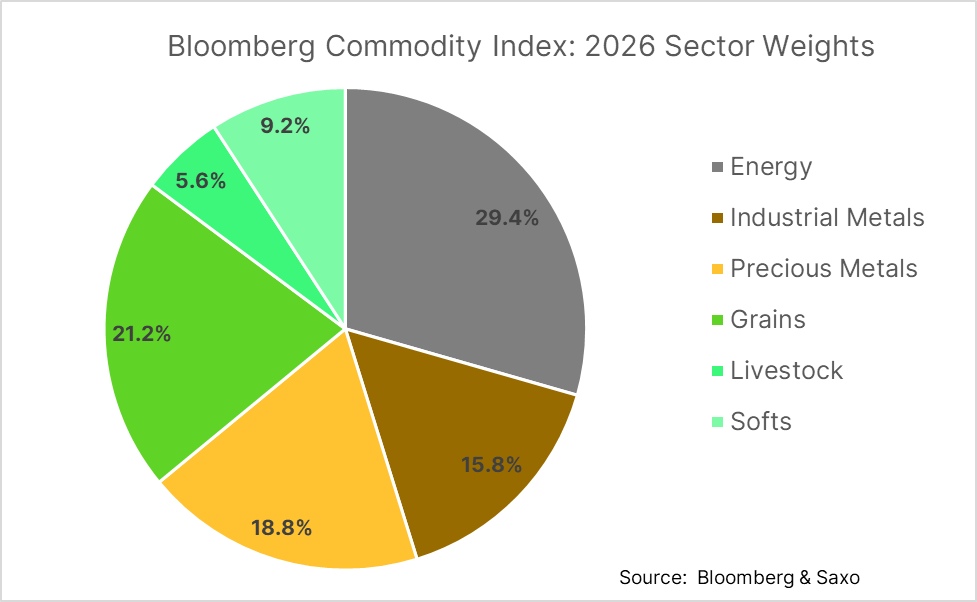
What is the Bloomberg Commodity Index (BCOM)?
The Bloomberg Commodity Index is a broad-based index that tracks a basket of major commodities including energy, metals, and agriculture. It’s followed by large passive funds and ETFs that mechanically adjust their holdings each year to match the index’s target weightings.
Because these adjustments are rules-based rather than discretionary, they often create temporary flows — not fundamental shifts in value.
The reality for precious metals
Nothing meaningful is stopping this move.
Gold is being driven predominantly by currency debasement — the consistent weakening of fiat currencies when priced against gold.
Much of the crowd believes this is because the US dollar is losing its global reserve-currency status. And while the dollar has lost some share over time, it remains the dominant reserve currency.
More importantly, this is not just a US-dollar story.
If you chart XAU against EUR, GBP, JPY, CHF, and others, you see the exact same outcome: gold making new highs in virtually every major currency. This is a global fiat issue, not a single-currency one.
On the BCOM rebalancing narrative
The BCOM rebalancing is an annual, rules-based event.
Looking back:
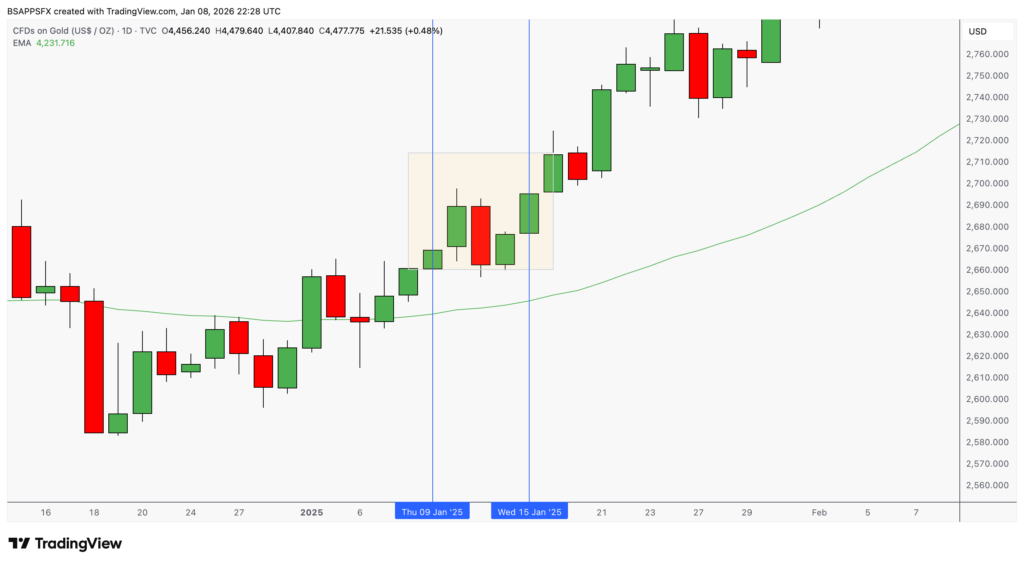
- 2025: January 9th–15th
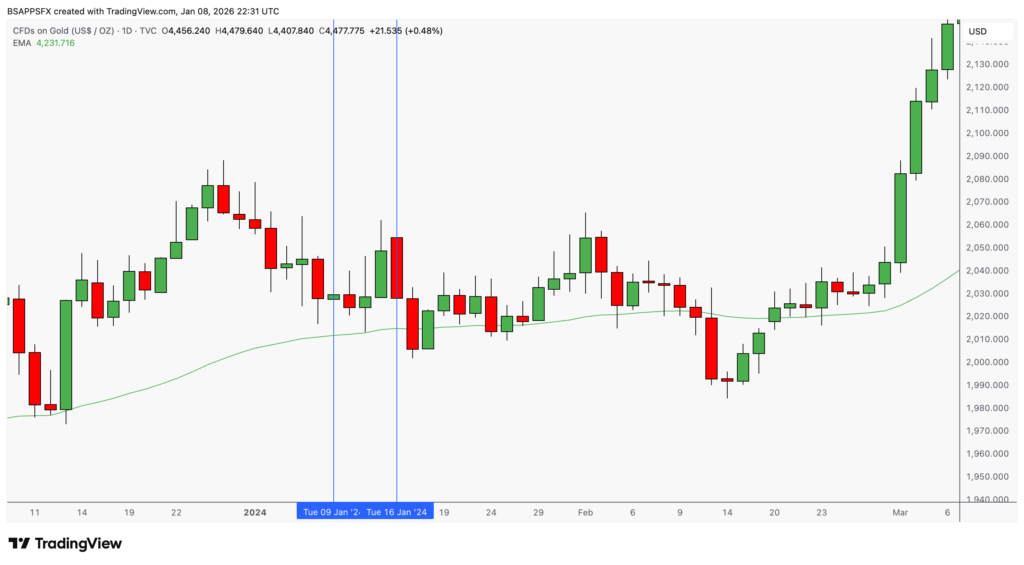
- 2024: January 9th–15th
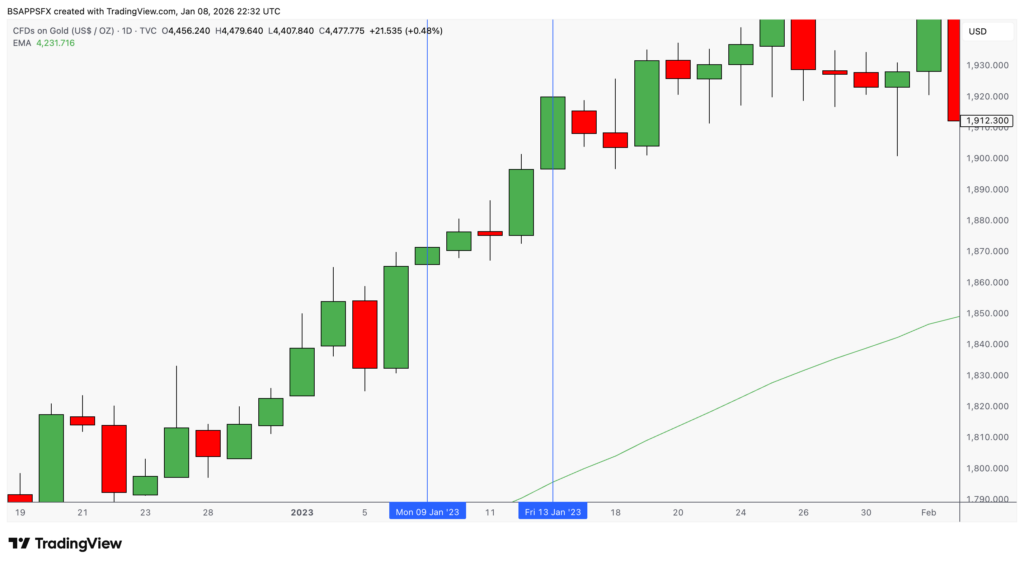
- 2023: January 9th–13th
If you back-test these windows on XAU/USD, you’ll notice something inconvenient for the bears — price went up, not down.
2025
2024
2023
Why gold and silver are “overweight”
For gold:
The 2025 target allocation was 14.29%. Gold gained 60%+ in 2025, meaning its weight drifted to approximately 20.4%. The 2026 target allocation is 14.9% — so BCOM needs to mechanically trim gold exposure to bring 20.4% back down to 14.9%.
For silver:
The 2025 target allocation was 4.49%. Silver gained 145%+ in 2025, meaning weight drifted to approximately 9%. The 2026 target is 3.94%. Again — mechanical trimming, nothing more.
Putting the numbers into perspective
Bloomberg’s flagship commodity indices track roughly $109 billion in assets.
Gold needs to be reduced by roughly 5.5% — that’s 20.4% minus 14.9%. 5.5% of $109bn equals approximately $6 billion of gold exposure to be reduced across the entire rebalance window.
Now compare that to actual market liquidity:
Spot and futures gold turnover runs $150–250bn per day. COMEX futures alone run $40–70bn per day. $6bn spread over 5 trading days equals approximately $1.2bn per day — roughly 1–3% of daily futures volume.
That’s not a shock. That’s background noise.
When would this actually matter?
For the rebalancing to have a meaningful impact, we would need all of the following simultaneously: thin January liquidity, one-sided selling with no buyers, no ETF demand, no central bank demand, and no geopolitical risk premium.
That simply isn’t the world we’re living in.
The real macro backdrop
We currently have multiple active geopolitical flashpoints, escalating tensions involving the US, Iran, Israel, Russia and Ukraine, central banks buying gold at any level, persistent ETF inflows, rate-cut expectations into 2026, and ongoing fiscal and monetary debasement.
All of this supports gold regardless of a mechanical index rebalance.
Final takeaway
BCOM rebalancing affects flows, not value. It may influence short-term volatility, but it does not change the underlying macro regime.
Any meaningful pullback should be viewed as a Black Friday sale. The macro backdrop supporting gold and silver has not changed — and until it does, buy every meaningful dip on pullbacks. Don’t fear them.
This article is for informational and educational purposes only. Nothing here constitutes financial advice. Always conduct your own research and consult a qualified financial adviser before making any investment decisions.
Get the next piece delivered direct to your inbox.